


























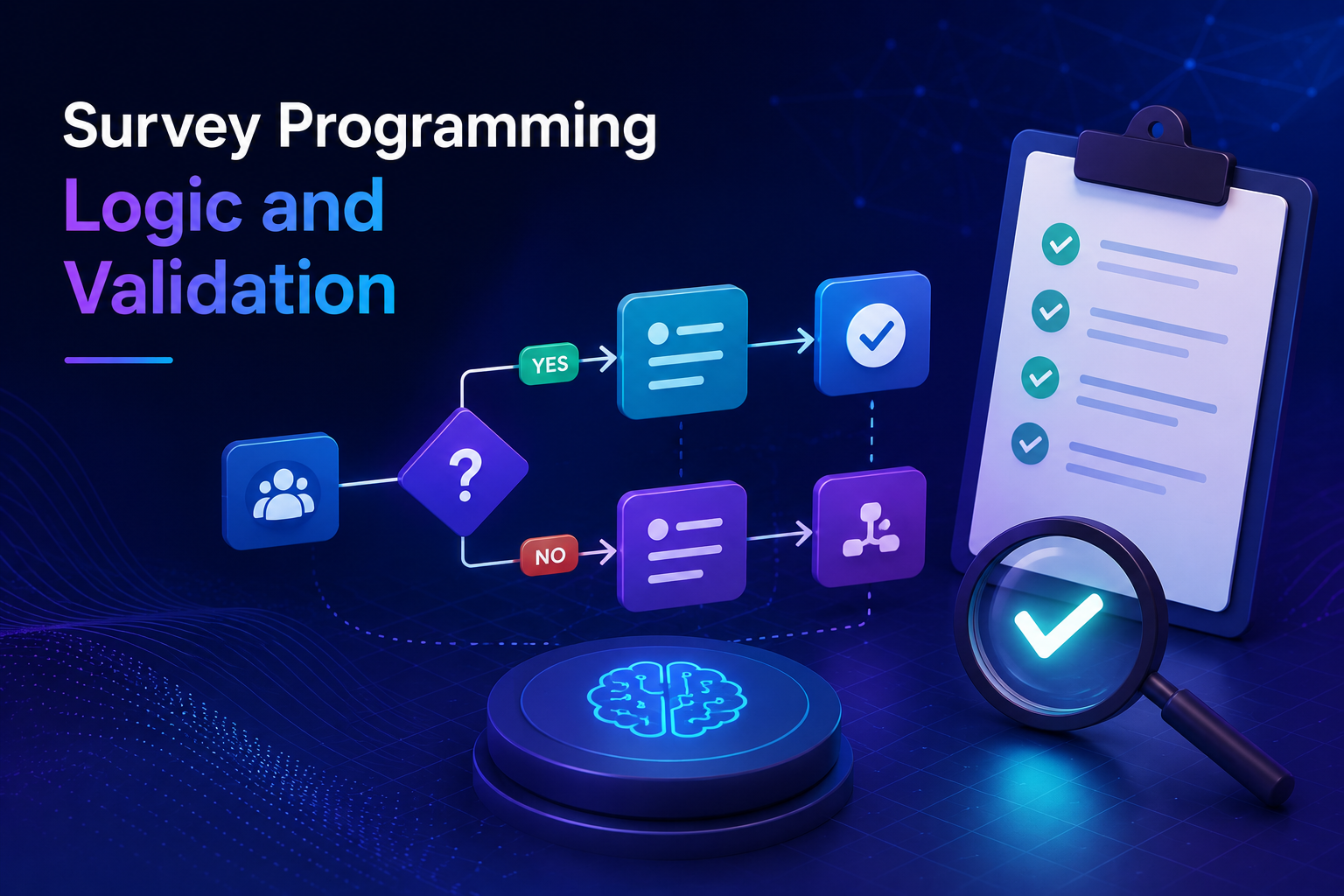
Survey programming plays a foundational role in modern market research. While survey design defines what questions to ask, survey programming determines how those questions are delivered, interpreted, and recorded. A well-programmed survey ensures logical flow, reduces respondent error, and produces clean, analysis-ready data.
This guide explains survey programming from an informational perspective — covering its purpose, core components, methodologies, and impact on data quality — to help researchers, analysts, and decision-makers better understand its role in the research lifecycle.
What Is Survey Programming?
Survey programming is the technical process of converting a questionnaire into an interactive digital survey using logic rules, validations, and automated behaviors. It governs how respondents move through a survey and how their responses are captured.
In the context of market research, survey programming ensures that:
- Respondents only see questions relevant to them
- Input formats are controlled and standardized
- Survey flow remains consistent across devices and audiences
Survey programming is commonly applied in online surveys, panel-based research, customer feedback studies, and large-scale quantitative research projects.
The Role of Survey Programming in Market Research
Survey programming sits directly between survey design and data collection. Even a well-designed questionnaire can generate poor-quality data if it is not programmed correctly.
From a research operations standpoint, survey programming helps:
- Translate research objectives into executable logic
- Maintain consistency across respondent groups
- Support complex study designs such as segmentation, quotas, and longitudinal tracking
As research increasingly relies on digital data collection methods, the importance of accurate and scalable survey programming continues to grow.
Core Components of Survey Programming
1. Survey Logic and Routing
Logic determines how respondents move through a survey based on their answers. Common logic elements include:
- Skip logic: Skipping irrelevant questions entirely
- Conditional branching: Showing tailored questions based on specific criteria
- Looping: Repeating question blocks for multiple selected items
Proper routing substantially improves the overall respondent experience and reduces survey fatigue.
2. Input Validation and Error Control
Validation rules ensure that collected responses strictly meet predefined operational criteria. Examples include:
- Numeric range checks
- Mandatory question enforcement
- Format validation (email addresses, dates, or custom IDs)
These proactive checks drastically reduce inconsistent or unusable responses at the point of data entry.
3. Randomization and Rotation
To minimize structural cognitive bias, advanced survey programming frequently incorporates:
- Randomized answer choices to counter order bias
- Rotated statements or brand attributes
- Randomized question blocks
These techniques are critically important in attitude measurement and competitive concept testing studies.
4. Personalization and Answer Piping
Personalization allows previous answers to be dynamically referenced later in the questionnaire text. This dynamic interaction improves structural clarity and engagement, especially in longer or more complex surveys.
How Survey Programming Improves Data Quality
From a rigorous data management perspective, survey programming decisions exert a direct impact on data accuracy, parsing capabilities, and end-stage usability.
Reduces Response Errors: By guiding respondents cleanly through relevant questions and validating inputs, programming eliminates incomplete responses, illogical answer combinations, and out-of-range values.
Minimizes Post-Field Data Cleaning: Well-programmed surveys require significantly fewer structural corrections during the backend processing stage, saving vital time during the analysis and reporting phases.
Supports Consistent Data Structures: Standardized response formats and controlled architectural logic produce datasets that are inherently cleaner to analyze, visualize, and integrate with standard BI tools.
Survey Programming and Complex Study Designs
Advanced technical programming enables research teams to seamlessly execute sophisticated research methodologies, including:
- Multi-country and multi-lingual global studies
- Strict quota-controlled sampling matrices
- Longitudinal tracker and tracking surveys
- Intelligent audience segmentation and screening
These integrated capabilities are absolutely essential for large-scale operations where manual oversight is highly impractical.
Relationship Between Survey Programming and Analysis
Upstream survey programming decisions heavily influence downstream analytical accuracy. Clean logic structures and fully validated inputs fundamentally support:
- Faster data cross-tabulation
- Reliable segmentation modeling
- Accurate historical trend comparisons
When survey raw data feeds live into automated visualization tools or executive dashboards, structured database programming ensures operational consistency and eliminates interpretation anomalies.
Common Survey Programming Best Practices
Experienced researchers and engineers typically structure deployment around these foundational principles:
- Keep surveys concise and highly logical
- Extensively test all edge-case logic paths before deployment
- Ensure seamless mobile and multi-device cross-compatibility
- Apply consistent, clean variable naming conventions
- Conduct a controlled soft launch or pilot test
Survey programming is a critical but often overlooked pillar of effective market research. By programmatically controlling logic, validation, and respondent flow, it ensures that digital surveys capture clean, unbiased, and actionable data.
Understanding this technical framework helps teams design better studies, anticipate downstream data challenges, and radically elevate the baseline quality of business intelligence insights.